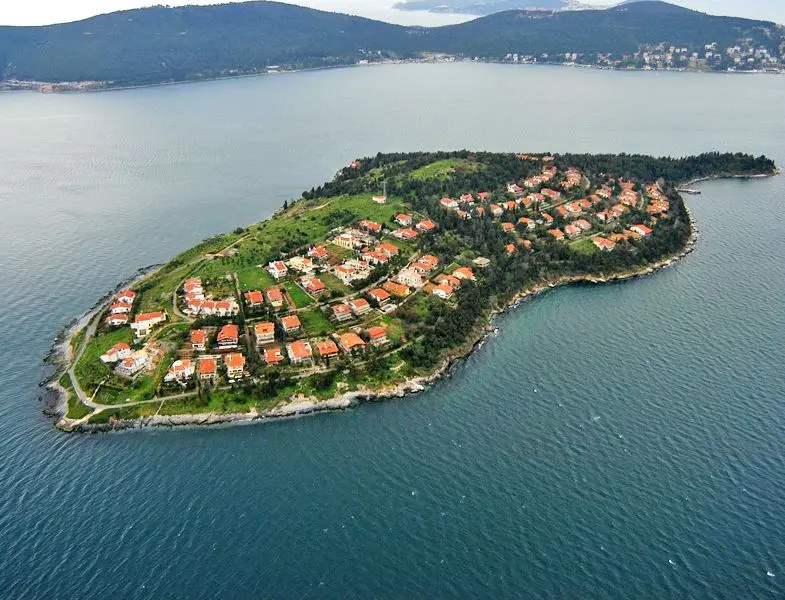
Sedef Island is the smallest and easternmost island in the Princes' Islands that is open to settlement. To the south lies Neandros Island, to the west Büyükada, and to the north the Kartal district.
Administratively, it is affiliated with the Büyükada Maden Neighborhood headman's office. The island covers approximately 33 hectares (Büyükada is about 16 times larger than Sedef Island). Its highest point is 55 meters.
It has gone through many name changes. In Byzantine and earlier sources, its earliest known name appears as Antirovythos / Antirobethos (Ἀντιρόβυθος). During the Byzantine period, its name later changed to Terebinthos (Greek: Τερέβυνθος). Terebinthos means "turpentine". Was the island once covered with terebinth (pistacia lentiscus) bushes?

Later, because it was home to many rabbits, it was also called Tavşanadası.
In the early years of the Republic, the island was named Sedef Adası (Mother-of-Pearl Island) because of the shimmering of the mother-of-pearl flowers (Lunaria annua) growing on the island in the sunlight.

Like the other islands of Istanbul, Sedef Island has also hosted monasteries and many exiles. One of the island's most famous exile episodes is the construction of its first monastery during the reign of Patriarch Leonidas and the exile of Patriarch Niketas Ignatios. Ignatios was appointed patriarch in 857 after Empress Theodora took power. But shortly after the empress was deposed, Ignatios was removed from office, tortured, and exiled to the monastery on the island. Ten years later, in 867, he was once again elected patriarch after Emperor Basil I ascended the throne.
Among the famous exiles sent to the island was Konstantinos, the son of Romanos Lekapenos, sent by VII Constantine (Porphyrogennetos) (Kedrenos, PG 122, c. 57). This episode is quite interesting, so we want to tell it in detail: Konstantinos Lekapenos and his brother Stefan believed they would keep all power if they overthrew their father, Emperor Romanos I Lekapenos. But things did not go as they hoped. This coup was a palace raid and a story of intrigue. It was 944. Father Romanos Lekapenos was in his seventies, seriously ill, and had turned to religion and prayer in fear of death. Moreover, his favorite eldest son (and heir), Christopher, had died a few years earlier. The two remaining sons, Konstantinos and Stefan, panicked when they heard rumors that their father would leave the throne not to them but to the legitimate son-in-law VII Constantine, and they made a ruthless plan. The brothers gained the support of the palace guards and some collaborators inside the court. On the night of December 20, 944, while the elderly emperor was sleeping or praying in his chamber of the Great Palace, a group of armed guards led by Konstantinos and Stefan stormed the room. The old and sick emperor was not given a chance to get up from his bed. Everything was carried out quickly and secretly to avoid making a loud disturbance in the palace. The coup brothers immediately put him on a boat at the palace pier to prevent his loyal men from rescuing him. In the darkness of night, they took him by sea directly to the nearest place of exile and confinement, Kınalıada (Proti). According to Byzantine law, the most certain way to prevent someone from becoming emperor again was to make him a cleric. As soon as old Romanos set foot on Kınalıada, his sons ordered his hair to be shorn (tonsure), his imperial garments removed, and a monk's robe forcibly put on him. The next morning, when the people of Constantinople woke up, they learned that the powerful emperor who had ruled for 24 years had become only a simple monk on Kınalıada.
But two great forces that the brothers had not anticipated came into play:
The People's Uprising: The people of Istanbul did not like the Lekapenos brothers and feared that the legitimate emperor VII Constantine would be killed by these two ambitious men. A large crowd gathered in front of the palace and rose up shouting, "We want to see our true emperor!"
The Palace Bureaucracy and Generals: When they saw the situation slipping out of control, powerful bureaucrats, commanders, and especially the emperor's ambitious wife Helena Lekapene (who was the biological sister of the coup brothers but chose the side of her lawful husband) rallied around Emperor VII Constantine.
The day Konstantinos Lekapenos thought he had seized power, he was captured in the palace by guards under the orders of VII Constantine. On January 27, 945, the legitimate emperor VII Constantine ascended the throne as sole absolute ruler and sent the two brothers who had plotted against him—Konstantinos and Stefan—into exile on the islands, thus ending the Lekapenos dynasty completely.
Konstantinos Lekapenos was first taken to Kınalıada to join his father and brother there. But soon after confronting his father, Emperor VII Constantine feared that the two brothers would stay on the same island and plot a new conspiracy. Therefore, Konstantinos Lekapenos was moved from Kınalıada to Terebinthos, that is, Sedef Island. Because Sedef Island was very close to Istanbul, he was later moved farther away to Samos and Lesbos. Konstantinos later tried to escape and was killed.
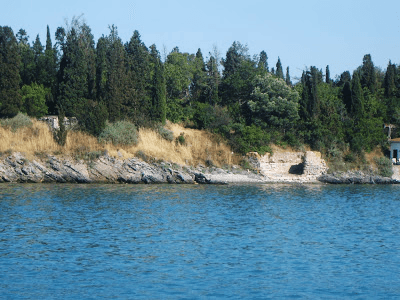
About two centuries later, after Patriarch Theodosios I Boradiotes (1178–1183) resigned, he had a house and a tomb built on Sedef Island and withdrew there. His life on the island is described in letters by Michael Choniates. The island had abundant wine, wood, water, fruit, myrtle, and cypress trees.
The island was sold in 1850 by Sultan Abdülmecid to Fethi Ahmet Pasha, the palace son-in-law and the Marshal of Tophane. The Pasha planted olive trees and grew vegetables on the island. However, his main reason for purchasing it was for fishing. Fish were abundant around the island, and they needed this land to haul their nets. After the Pasha died, the island was neglected, and during World War I all the trees on the island were cut down. After the conquest of Istanbul, the occupying forces placed the ship Yavuz on the island and left it abandoned.
In later years, ownership of Sedef Island was divided among the heirs of Fethi Ahmed Pasha through inheritance and various share transfers. Records from the 1930s show that the island had a fragmented ownership structure, with some shares becoming subject to debt, mortgage, and foreclosure proceedings. Over time, this structure changed again through inheritance, sales, and transfers of shares within the family. Rey’an Şehsuvaroğlu’s own account indicates that she inherited a share of Sedef Island from her mother and later purchased another relative’s share. By the 1950s, Şehsuvar Menemencioğlu and Rey’an Şehsuvaroğlu, descendants of Fethi Ahmed Pasha, had assumed a decisive role in reorganizing the island and preparing it for settlement.
Planning and development work launched in 1956 aimed to reforest and subdivide Sedef Island and transform it into a low-density summer resort settlement. During the same period, efforts began to establish a housing cooperative on the island. This marked the beginning of a new era in Sedef Island’s history, laying the foundations of its present-day settlement pattern.
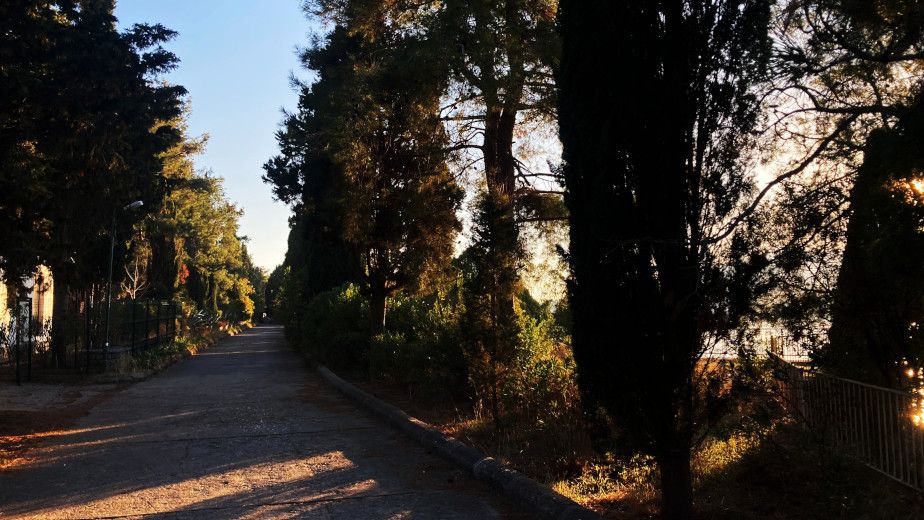
Approximately 40,000–50,000 trees were planted during this process. Over time, the thousands of saplings, primarily pines, completely transformed the island’s appearance and formed the basis of the dense green landscape that is now one of Sedef’s defining features.
Reforestation and construction were not treated as separate undertakings. During the same period, work began to establish a controlled settlement through a housing cooperative. Newspapers of the period also reported in the summer of 1956 that Sedef Island would be developed as a new summer resort, with shared and tourist facilities such as a beach, hotel, and casino planned alongside housing.
Architect Kadri Eroğan undertook the planning of the new settlement. The 1:1000-scale Sedef Island Development Plan was approved on July 6, 1956. The plan treated the curving roads that followed the island’s topography, residential areas, extensive green spaces, and shared coastal areas as an integrated whole. The aim was not merely to build new houses, but to create a new summer resort landscape compatible with the island’s natural character by considering reforestation, architecture, and settlement planning together.
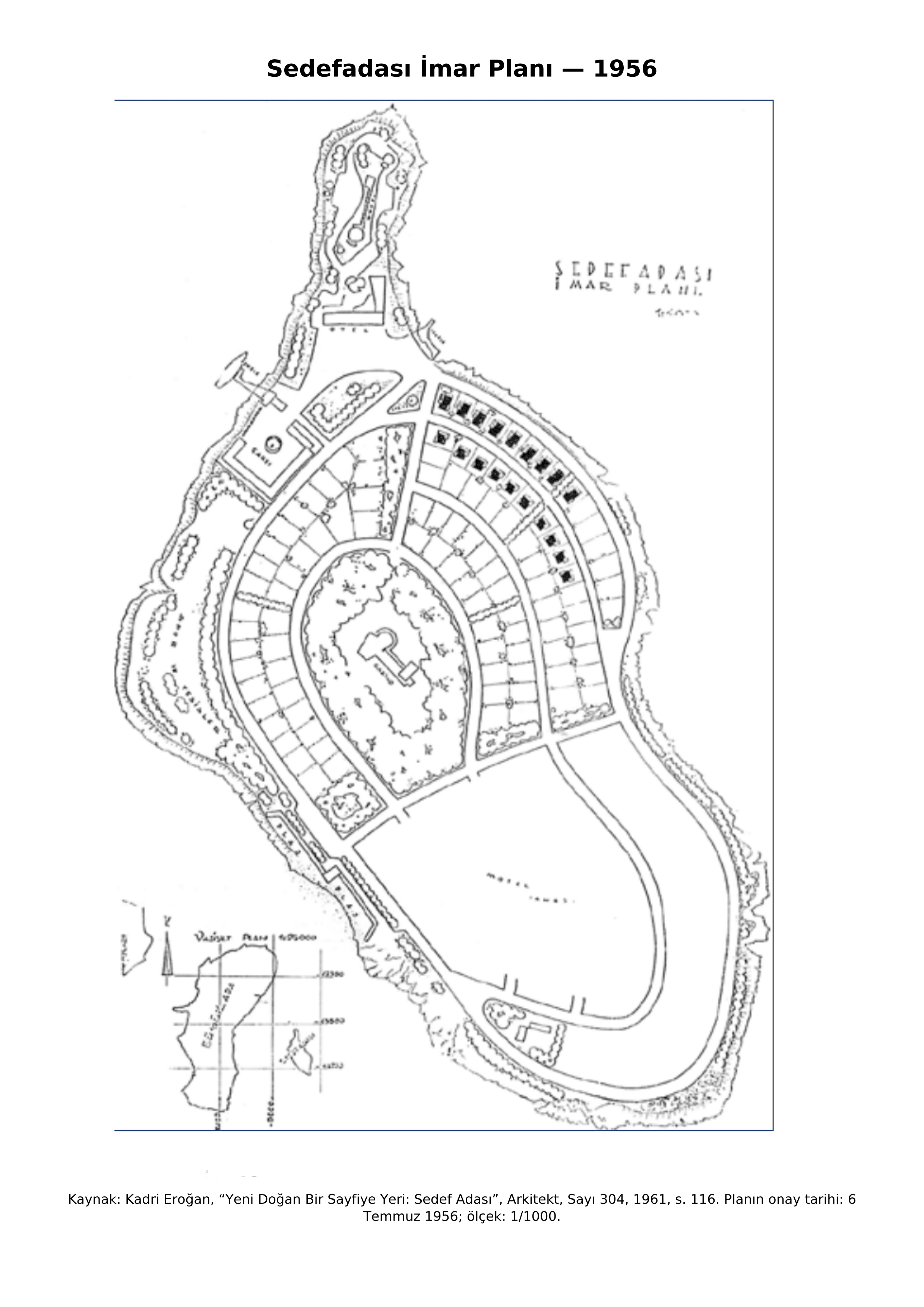
Kadri Eroğan later presented the project in detail in his article “A Newly Born Summer Resort: Sedef Island,” published in issue 304 of Arkitekt magazine in 1961. Seven different house types were designed to meet varying needs in the initial settlement. Sources refer to approximately 50–60 houses in the first phase. The houses were designed at low density, set within gardens, and intended to preserve the island’s summer resort character.
Rules were established not only for the settlement’s initial construction but also for how it would be preserved in the future. At the time, the cooperative known as the “Sedef Island Tourist Facilities and Buildings Cooperative” stipulated that buildings could not depart from its approved types, their exterior appearance could not be altered, and arbitrary outbuildings, chicken coops, sheds, or similar additions could not be constructed on the plots. Gardens were also not permitted to be separated by high walls or wooden screens. These rules played an important role in creating the settlement pattern that remains one of Sedef Island’s distinctive features today: homes set within gardens, integrated with greenery, and not divided by rigid boundaries.
The first residents largely came from Şehsuvar Menemencioğlu’s close circle and university friends. Melek Yamaner, one of the first-generation residents, recounts that her husband, Cemal Yamaner, was Şehsuvar Menemencioğlu’s university classmate and that Şehsuvar Bey invited his friends to Sedef. In Yamaner’s recollections, sculptor Zerrin Bölükbaşı, painter Ercüment Kalmuk, and İhsan Kent are also named among the early neighbors. Melek Yamaner’s account that only a few houses existed when they first arrived on the island shows that Sedef initially developed as a small community whose members knew one another.
By the early 1960s, the new settlement had begun to take clear shape. As the number of houses increased, electricity, transportation, and shared facilities also developed. Following requests from island residents, efforts were made to establish a ferry connection between Sedef and Istanbul; by the end of 1962, the City Lines administration was announcing “Sedef Island–Bostancı trial services.” Thus, the new summer resort settlement, initially home to a limited number of families, gradually became part of Istanbul’s island life.
Over time, the cooperative model gave way to a shared management structure run by the island’s residents, and the settlement reached its present form of approximately 110 houses. After Şehsuvar Menemencioğlu’s death in 1986, the family’s property passed to Esra Bereket and Mehmet Birgen, the children of Rey’an Şehsuvaroğlu.
The legacy of the settlement planning and reforestation initiative that began in 1956 remains exceptionally well preserved on Sedef Island today.